A certificate or test report can look authoritative and still fail to answer the buyer’s question if it names a different factory, product family, model, standard, or market. For building products, review documents as a connected evidence set: identify the exact product and intended use, understand what each document demonstrates, check its scope and status, and confirm that labeling and shipment records refer to the same approved configuration.
Key takeaways
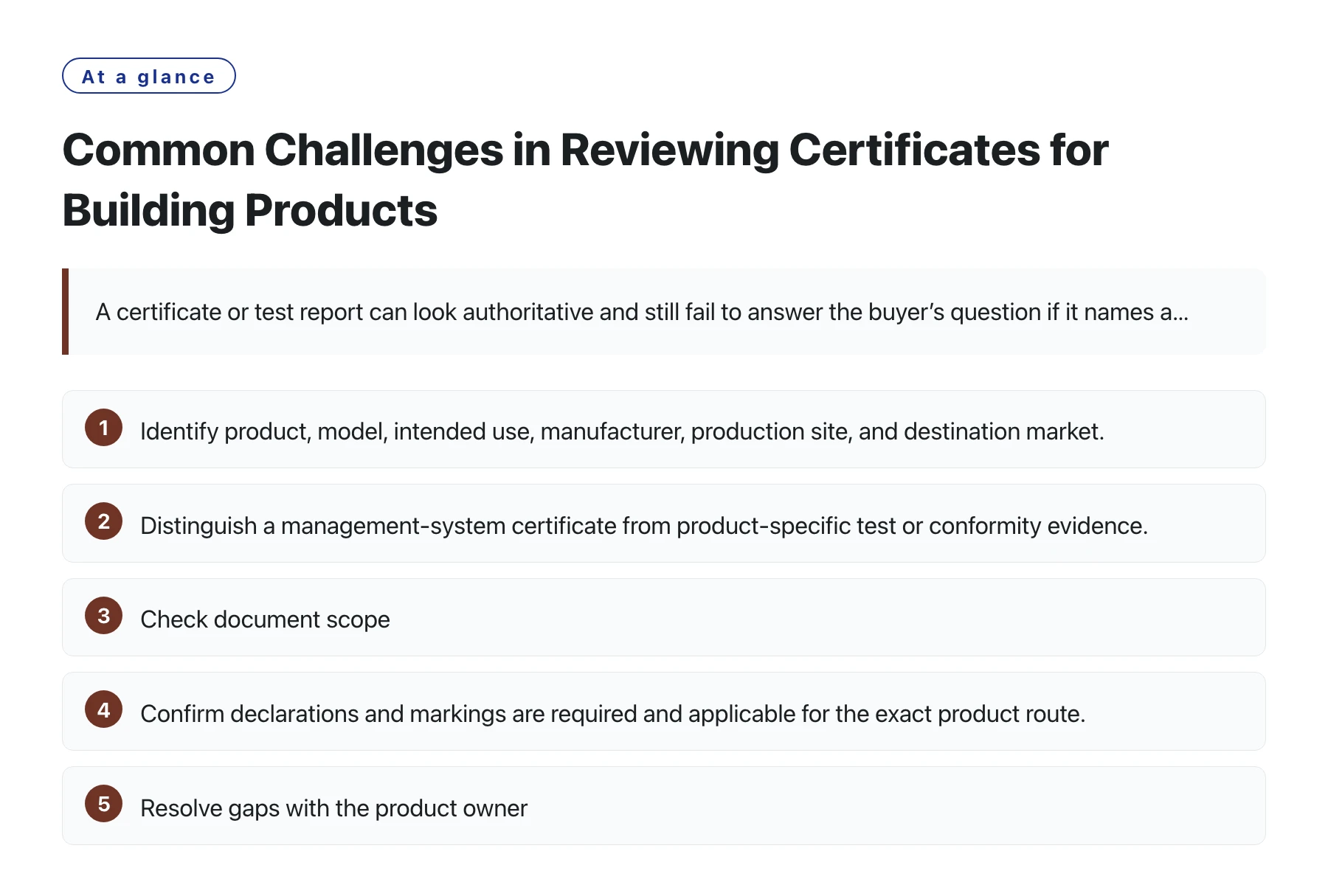
- Identify product, model, intended use, manufacturer, production site, and destination market.
- Distinguish a management-system certificate from product-specific test or conformity evidence.
- Check document scope, standard edition, sample identity, issuing body, date, and limitations.
- Confirm declarations and markings are required and applicable for the exact product route.
- Resolve gaps with the product owner, qualified compliance reviewer, or issuing organization.
Construction-product obligations vary by product family, intended use, and market. A generic factory certificate should not be treated as product approval.
First identify what the document is meant to prove
Begin with the buyer’s question. Is the document evidence of a factory management system, a test of a product characteristic, a declaration by the manufacturer, an inspection result, or an authorization for a specific market? These documents have different purposes. Record the claim each one is being used to support and the requirement behind that claim. If no one can state the claim clearly, the document may be present in the file without resolving a real decision.
Separate organization-level evidence from product-level evidence. A quality-management certificate describes a defined system and scope; it does not automatically demonstrate fire performance, load capacity, emissions, dimensions, or suitability for a building application. A laboratory report may address a test sample and a specific method but not establish factory controls or cover every product variant. A declaration may summarize declared performance for a defined product under a regulatory route.
Importers sourcing wholesale construction materials from China should request the product identity and evidence before finalizing the specification. Explain the intended installation and use, destination market, critical characteristics, and who will assess the documents. A certificate without this context can be difficult to interpret and may not correspond to the contract requirement.
Check product identity and scope
Compare the document’s manufacturer name, production address, product family, model, components, intended use, and variant with the quotation and approved sample. Similar trade names are not enough when models differ in construction or declared performance. If a certificate lists a factory but the order will be produced at a different site, ask whether the document covers that location and process. Keep the answer in writing and link it to the relevant order.
Read the scope and exclusions, not only the title page. Look for covered products, applications, characteristics, test methods, standard editions, and any limitations. A document for an interior product may not apply to an exterior application; a test on one substrate or thickness may not support a different configuration. If the report references annexes or schedules, obtain them and verify the product appears there.
Check dates and status. Confirm whether a certificate remains valid, whether the issuing body can verify it, and whether an applicable standard or regulatory route has changed. For test reports, note when samples were received and tested, who selected them, and whether they were representative of production. An old report is not automatically invalid, but the buyer should understand whether design, material, site, and requirements have changed since testing.
Understand declarations, markings, and market routes
Do not assume a CE mark or other logo is a general quality award. Markings have meaning only within the rules and product scope that apply. The European Commission explains that, under the Construction Products Regulation routes it describes, CE marking follows the required declaration and technical documentation, and applies where a product is covered by a harmonised technical specification or relevant European Technical Assessment. The exact applicable route depends on the product and current rules. [1]
For a product intended for the European Union, establish whether the relevant construction-product regime applies and which declaration, assessment, labeling, and documentation provisions govern the exact product. The transition between regulatory frameworks can affect which documents and procedures are appropriate. Ask a qualified compliance owner to check current official material and the product’s specific technical specification; do not copy requirements from a different product category.
For destinations outside the EU, identify that market’s own rules. A report or mark accepted in one jurisdiction may not satisfy another. Clarify who is the importer, who is responsible for conformity assessment, what language is required for instructions or declarations, and which records must accompany the product. Do this before production because label, test, and packaging changes can affect lead time and cost.
Trace test reports to the tested sample
A test report should identify the issuing laboratory, customer, sample description, model or type, receipt and test dates, method, results, and any deviations or exclusions. Verify that the report actually measures the characteristic the buyer needs. A report title mentioning a standard is not enough if the tested material or configuration differs from the offered product. Ask the supplier to map the report to the bill of materials and the specific purchase model.
Check who selected and submitted the sample and how it relates to routine production. A factory-submitted specimen can be useful evidence, but it may not show that later units use the same material or process. For repeat orders or high-consequence features, combine testing with change control, production records, and appropriate inspections. Keep the sample identifier and report reference together in the product file.
Review results against declared limits and acceptance criteria. A pass/fail statement may not include the detail needed to evaluate a design tradeoff or destination requirement. Ask for the measured values, uncertainty or method notes where relevant, and the applicable decision rule. If a report has been translated or summarized, obtain the original and confirm that the summary preserves scope and limitations.
Verify issuers, signatures, and document integrity
Confirm the issuing organization and the identity of the person or body that signed the document. Use the issuer’s official verification process when available. Check whether an accreditation or notification claim is relevant to the test or assessment at issue, and verify that the claimed scope covers that activity. A logo alone does not establish that a document is authentic or that the issuer has authority for the specific product route.
Look for signs of mismatch or alteration: inconsistent fonts, model numbers that change between pages, missing annexes, a scope that does not mention the product, unexplained dates, or a supplier name different from the offer. These observations warrant clarification; they are not by themselves proof of wrongdoing. Request a complete original or direct confirmation from the issuer when the document affects a material decision.
Maintain a controlled copy with source, date received, language, version, and internal reviewer. If a new certificate or report replaces an earlier file, record what changed and whether the change affects the approved product. Avoid relying on screenshots or cropped pages if the scope, issuer, or conditions appear elsewhere in the full document.
Connect documents to production and shipment
Include agreed model, material, supplier site, and document references in the purchase specification. Tell the factory that substitutions require review where they could affect declared performance or test evidence. Define how the current revision is identified at production, inspection, packing, and receiving. Without this link, valid documents can become disconnected from the goods eventually shipped.
Before release, reconcile the approved specification, declarations, labels, test reports, inspection findings, quantity, and packing list. Check that carton labels and technical documents identify compatible product versions. If any file remains pending, name the responsible reviewer and decide whether dispatch must wait. The decision should reflect contract terms and applicable rules, not just the supplier’s schedule.
For future orders, monitor changes to the product, factory, process, regulation, or referenced standards. Ask the supplier to notify the buyer before making a change that could invalidate an existing report or declaration. Keep a review date or trigger for rechecking evidence when a standard is revised, a new market is added, or a product variant is introduced.
Resolve gaps with a practical escalation path
Create a document register with the requirement, document type, product and site covered, issuer, date, status, reviewer, and open issue. A simple status such as received, under review, accepted for stated purpose, or replacement required is clearer than a folder of mixed files. Add a short note explaining why an item is accepted and what it does not establish.
When evidence is incomplete, ask targeted questions: Which exact product is covered? What intended use was assessed? Which version of the standard was applied? What sample was tested? Does the issuing body verify the document? Is the production site included? What additional step is required for the destination market? The answers help decide whether to request a corrected record, additional test, technical assessment, revised label, or professional review.
Do not resolve uncertainty by enlarging a document’s meaning. If the evidence cannot support a required claim, record the gap and pause the affected decision until the appropriate owner determines a safe path. A transparent record protects the buyer, supplier, and downstream project team from assuming that a generic certificate substitutes for product-specific evidence.
Sources
Frequently asked questions
Does a factory quality certificate prove a building product meets code?
No. A management-system certificate has a defined scope and does not by itself establish product performance or regulatory compliance for a specific market.
Is a CE mark proof that a product is high quality?
It is a regulatory marking used within applicable EU product rules, not a general quality rating. Confirm the exact product route, documentation, and declared characteristics.
What should I match on a test report?
Match the product model, configuration, manufacturer or site, tested sample, method, results, dates, and limitations to the specification and intended use.
What if a supplier certificate names a different factory or model?
Ask the issuer or supplier for a verified scope explanation or corrected evidence. Treat the mismatch as unresolved until a qualified reviewer determines whether it applies.