A trend only becomes a compliance problem when it turns into a claim on the pack. Clean, refillable, natural, long-lasting, dermatologically tested: each of these words pulls a specific document behind it, and in the EU that document has to exist before the product is placed on the market rather than after a retailer asks. The practical way to manage this is to treat the claim list as a purchasing document. Decide the claims first, then let each claim name the paperwork it requires, and the launch calendar will stop being a surprise.
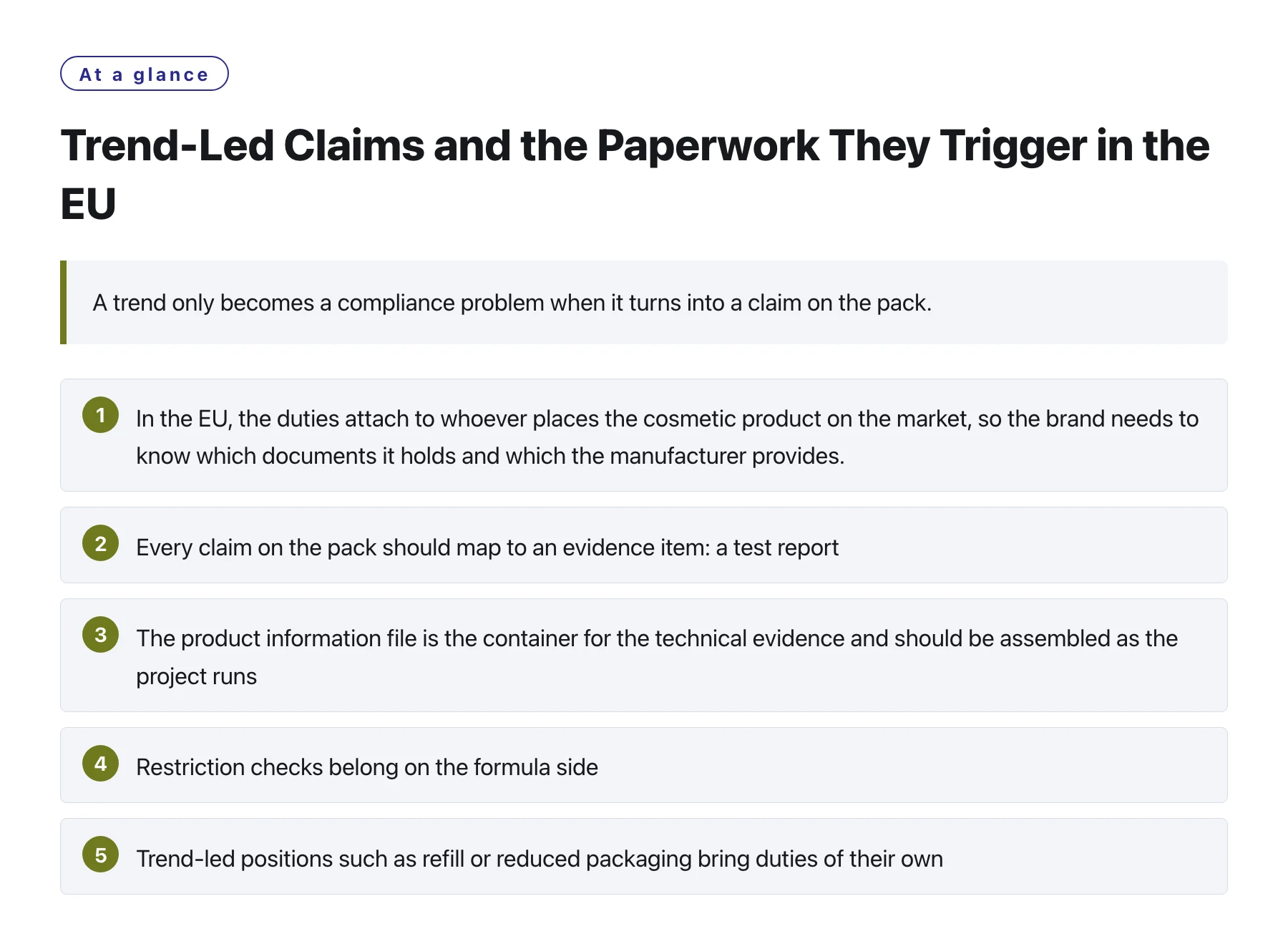
Key takeaways
- In the EU, the duties attach to whoever places the cosmetic product on the market, so the brand needs to know which documents it holds and which the manufacturer provides.
- Every claim on the pack should map to an evidence item: a test report, a specification, a statement of origin or a dated declaration.
- The product information file is the container for the technical evidence and should be assembled as the project runs, not reconstructed at the end.
- Restriction checks belong on the formula side, because permitted concentrations depend on product type and can change as substances are reviewed.
- Trend-led positions such as refill or reduced packaging bring duties of their own, which are easiest to absorb if the pack decision is made early.
- The strongest predictor of a smooth launch is not the length of the certificate list but whether one named person owns the file.
Compliance deadlines are usually discovered by a launch manager reading a distributor email three weeks before a ship date. The pattern repeats because claims are chosen in a marketing meeting and documents are collected later, by someone who has to reconstruct decisions that were never written down.
This is a map written from the compliance seat. It lists the papers an EU-bound fragrance launch normally needs, says who prepares each of them, and marks the point in the project where each one has to exist. It also flags the claims that look free in a deck and are not free in practice.
Nothing here replaces the specific advice of the responsible person for your product. It is a planning document, meant to make the conversation with that person shorter and better informed.
The document map for an EU-bound fragrance launch
| Document | Who normally prepares it | When it has to exist |
|---|---|---|
| Formula specification with ingredient percentages | The manufacturer or perfumery house that owns the formula | Before the safety assessment is commissioned |
| Safety assessment inputs, including toxicological data | The assessor, working from the manufacturer's specification | Before the product is placed on the market |
| Allergen declaration and labelling wording | The manufacturer for the formula; the brand for the label | Before artwork is signed off |
| Restriction and prohibition check against the current ingredient database | The manufacturer, ideally with the brand confirming the product type | At formula selection and again at bulk release |
| Material safety data sheets for aroma materials | The material suppliers, collected by the manufacturer | Before bulk production |
| Stability and compatibility report in the final pack | The manufacturer's laboratory | Before the pack is approved for the range |
| Batch record and certificate of analysis | The manufacturer's quality department | At each bulk release |
| Claim substantiation file | The brand, with test evidence from the manufacturer or a laboratory | Before the claim appears in any channel |
The right-hand column is the part most projects get wrong. A document that arrives after artwork approval forces the label to be reprinted, and that cost lands on the brand, not on the factory.
Why the ingredient database is a moving target
European cosmetic rules restrict how a substance may be used according to product type and concentration, and the entries are updated as scientific opinions are published. That is why a formula that was acceptable for a body mist may not be acceptable for a leave-on fragrance, even though the two products share most of their materials.
The Commission maintains the ingredient database that lists permitted and restricted substances with their conditions of use, which is why the restriction check is a task rather than a formality [1]. A manufacturer that compounds on site usually runs that check as part of formula selection, because the same restriction logic applies across every project it develops.
The scientific committee that advises on consumer safety is the other half of the picture. Its opinions drive the changes that later appear in the restriction lists, and reading them at the direction stage is a cheaper habit than reacting to a reformulation request mid-campaign [2].
For a brand, the operational lesson is to treat the formula specification as a live document with a version number. The same discipline applies to safety testing in perfume manufacturing, where the test has to be defined before it is run rather than after a number appears. If the specification is undated and unversioned, no one can say which version the safety assessment was based on.
Trend claims and the evidence each one carries
Ingredient transparency claims need a specification the brand is allowed to see and, where relevant, a statement about the nature and function of the materials used. In practice this means agreeing at contract stage which parts of the formula the brand will receive and in what form, because no manufacturer hands over a full formula without a commercial agreement in place. A house such as Xuelei Perfume, which develops and produces on one site, can usually settle that split faster, since the same team holds the formula and the file.
Performance claims need method. Long-lasting is a testable proposition if the test conditions and the panel are defined; without them it is a sentence that a retailer or a competitor can challenge. The requirement to hold evidence for claims made to consumers is well documented in European practice, and cosmetics associations publish guidance that compliance teams use as a working reference [3].
Free-from positions are the most easily misunderstood. A fragrance does not usually become safer because one material family has been excluded, and the claim still needs a specification behind it to demonstrate that the exclusion is real and maintained across batches.
Refill and packaging claims sit in a different regime again. Reusability, refill rates and material content are now regulated questions as well as marketing ones, so a refill position has to be designed with filling and pack qualification in mind from the start [4].
Building the file while the project runs
- List the claims before the briefWrite every sentence you intend to publish about the product, then mark each one as either descriptive or evidential. Evidential claims need a named owner and a due date.
- Ask the manufacturer which documents it issues as standardAsking a Chinese fragrance manufacturer since 1994 what it issues as standard is itself a useful test: a producer used to regulated markets describes its document pack in one reply, and that reply shows whether it understands the difference between a specification and a certificate.
- Name the responsible person and the file holder earlyThe file has to live somewhere, and one person has to be able to produce it on request. Deciding this after production starts creates a fortnight of confusion.
- Freeze artwork only after the labelling documents are in handAllergen wording and required statements come from the formula and the product type, so artwork approval is the point of no return for a label.
- Keep a version logOne page listing each document, its version, its date and who approved it prevents the most common audit finding, which is simply not knowing which revision is current.
A question worth asking a fragrance manufacturer before signing: after we place the order, who will answer a question from our regulatory contact within two working days, and in what form? If a contract manufacturer for perfume brands cannot name a person and a channel, you are likely to become the project's documentation department yourself.
Sources
- EU CosIng — Cosmetic Ingredient Database (European Commission) —— The European Commission's CosIng database of cosmetic ingredients, listing ingredient functions, restrictions and labelling requirements under EU cosmetics law.
- EU Scientific Committee on Consumer Safety (SCCS) —— The EU scientific committee that issues opinions on the safety of cosmetic ingredients, including fragrance allergens and their labelling thresholds.
- Cosmetics Europe —— The European trade association for the cosmetics and personal care industry, publishing guidance, positions and market information.
- European Commission: Packaging Waste and the PPWR —— EU rules on packaging and packaging waste, including the Packaging and Packaging Waste Regulation requirements on recyclability and design.
Frequently asked questions
Who is legally responsible for an EU fragrance launch?
The party that places the cosmetic product on the market carries the duties, which is normally the brand rather than the factory. The manufacturer supplies technical inputs, but the brand is the one that has to be able to produce the file.
Can a factory's ISO certificate replace the product information file?
No. A certificate describes a management system, while the file contains the technical evidence for the specific product. Both are useful, and they answer different questions.
How early should a claim be tested?
Before the claim is written into artwork or advertising. Testing after the campaign has been produced means either dropping the wording or accepting a risk that would have cost far less to avoid.
Do refillable formats create extra paperwork?
They create extra questions rather than necessarily extra files: whether the refill is compatible with the original pack, how durability is demonstrated and what the packaging rules require for the components used.
What should a brand request with each bulk shipment?
A batch record reference and a certificate of analysis for the batch, plus confirmation that the specification revision used matches the one the assessment was based on.
Is a fragrance safety report the same as a cosmetic product safety report?
Not the same document. The fragrance industry's own safety programme supports safe use of materials, while the cosmetic report covers the finished product in its pack. A launch usually needs both kinds of input.