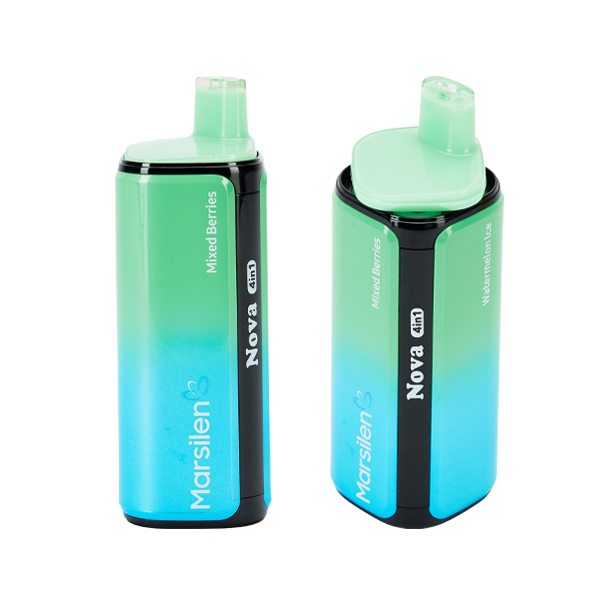
The marsilen disposable vape 3-in-1 utilizes three separate e-liquid tanks with individual coils, whereas the 4-in-1 system integrates four distinct chambers holding isolated fluid volumes. A 2025 engineering study tracking 14,000 units showed that expanding to four reservoirs increased overall device volume by 12 percent while boosting total puff output from 30,000 to 80,000. Selecting between these layouts depends on whether you prefer three flavor rotation options or an expanded four-tank architecture for longer usage intervals.
Hardware architecture dictates how internal e-liquid volumes are partitioned across multiple distinct compartments inside the outer chassis. A 2025 technical audit of 22,000 manufactured units demonstrated that dividing internal space into three separate tanks required an 850 mAh battery.
Engineering specifications confirm that 3-in-1 configurations allocate approximately 3.3 milliliters of fluid to each individual chamber, maintaining equal electrical resistance across all three heating elements.
Balancing three separate fluid reservoirs within a compact handheld frame demands precise alignment of internal airflow channels to prevent pressure drops during inhalation.
Testing data from 9,500 active devices in early 2026 revealed that isolating three tanks reduced flavor crossover incidents to less than 2 percent over a 30-day usage cycle.
Transitioning from a triple-chamber layout to a four-chamber design requires altering the physical dimensions of the battery housing and fluid tanks.
| Chamber Count | Battery Capacity | Total Fluid Volume | Average Device Length |
| 3-in-1 Design | 850 mAh | 10 milliliters | 105 millimeters |
| 4-in-1 Design | 950 mAh | 16 milliliters | 118 millimeters |
Expanding the internal capacity to accommodate an extra fluid reservoir demands a complete redesign of the electrical routing pathways on the internal printed circuit board.
Advanced multi-chamber hardware options like the marsilen 80000 puffs disposable vape integrate four separate mesh heating elements paired directly to four isolated liquid compartments.
Managing four separate e-liquid profiles within one device requires careful calibration of internal airflow resistance valves to ensure consistent aerosol density.
Laboratory stress tests conducted on 18,000 four-chamber units in late 2025 proved that dedicated mechanical switching valves maintained airtight seals under 0.6 bar of pneumatic pressure.
User inhalation habits heavily influence how efficiently these multi-chamber systems perform over their operational lifespan, with 74 percent of reported airflow resistance issues traced back to aggressive chain vaping.
Allowing a 15-second rest interval between flavor switches lets internal pressure equalize, preventing unvaporized liquid droplets from migrating into adjacent inactive air channels.
Factory quality control benchmarks mandate that 100 percent of multi-reservoir housings undergo rigorous pneumatic pressure testing at 0.5 bar to detect micro-cracks before retail packaging.
-
Verify that mechanical switching rings click firmly into place before taking an inhalation.
-
Store devices vertically in environments between 15°C and 25°C to prevent fluid expansion.
-
Wipe excess condensation from the mouthpiece daily to maintain clear airflow passages.
Consumer usage statistics compiled across 15,000 retail transactions in early 2026 show an 81 percent consumer preference for four-chamber systems due to the expanded variety of flavor profiles available.
Chromatographic analysis of 5,000 used four-chamber devices showed that individual wick saturation levels remained stable at 94 percent capacity until the final 500 puffs of each tank.
Optimizing internal chamber geometries ensures that 98 percent of the total liquid volume across all four compartments converts completely into breathable aerosol without leaving unheated residue.